Trigonometry
Trigonometry lets us relate the sides and angles of triangles, and describe points and rotations using angles. The labels used throughout: a triangle has sides $a$, $b$ and $c$, with angles $A$, $B$ and $C$ opposite the corresponding sides.
Sine and Cosine Rules
For any triangle the sine rule holds:
$\dfrac{a}{\sin A}=\dfrac{b}{\sin B}=\dfrac{c}{\sin C}$
Note: the sine of an angle $\theta$ equals the sine of its supplement $\pi-\theta$ ($180^\circ-\theta$), so the sine rule can be ambiguous for obtuse triangles. As a precaution, calculate all three angles and check they sum to $\pi$ ($180^\circ$); if the sum falls short, the angle opposite the longest side is probably obtuse.
For the same triangle the cosine rule holds:
$a^2=b^2+c^2-2bc\,\cos A$
When $A=\pi/2$ the triangle is right-angled and the cosine rule reduces to Pythagoras's theorem, $a^2=b^2+c^2$.
For a right-angled triangle, with $C$ the angle, side $b$ adjacent, side $c$ opposite and side $a$ the hypotenuse:
$\sin C= \dfrac{c}{a}$, $\cos C= \dfrac{b}{a}$, $\tan C= \dfrac{c}{b}$
A common mnemonic is SOH-CAH-TOA: $\sin=\dfrac{\text{opposite}}{\text{hypotenuse}}$, $\cos=\dfrac{\text{adjacent}}{\text{hypotenuse}}$, $\tan=\dfrac{\text{opposite}}{\text{adjacent}}$.
Example 1: Find the angles of a triangle with sides $a=4$, $b=5$ and $c=6$.
Use the cosine rule for the first angle:
| $A$ | $=$ | $\cos^{-1}\!\left(\dfrac{b^2+c^2-a^2}{2bc}\right) = \cos^{-1}\!\left(\dfrac{25+36-16}{60}\right) = 0.72$ rad ($41.41^\circ$) |
| $B$ | $=$ | $\cos^{-1}\!\left(\dfrac{a^2+c^2-b^2}{2ac}\right) = 0.97$ rad ($55.77^\circ$) |
| $C$ | $=$ | $\cos^{-1}\!\left(\dfrac{a^2+b^2-c^2}{2ab}\right) = 1.45$ rad ($82.82^\circ$) |
Sanity check: $0.72+0.97+1.45=3.14$ (or $41.41+55.77+82.82=180$) ✓. Calculating all three angles (rather than subtracting two from $\pi$) lets you catch mistakes.
Cartesian and Polar Coordinates
The Cartesian system (after René Descartes) describes a point by its $x$ and $y$ coordinates. The polar system describes the same point by a radius $r$ and an angle $\theta$ from a fixed line — widely used in navigation.
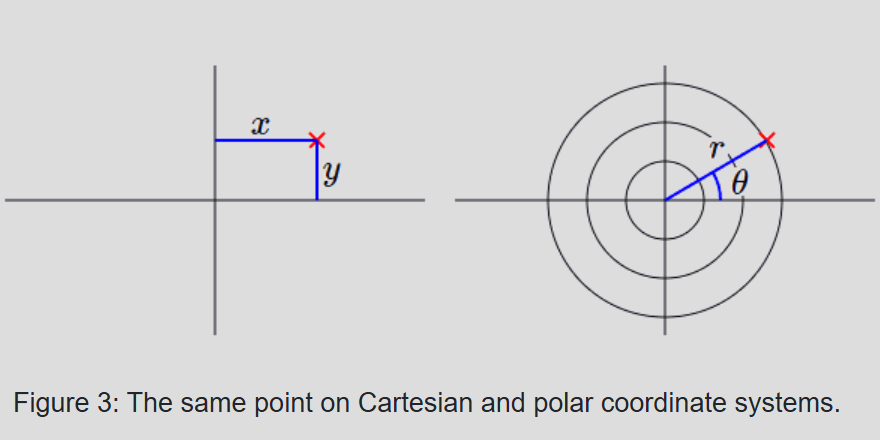
Cartesian to polar:
$r^2=x^2+y^2$, $\theta = \tan^{-1}(y/x)$ (choosing $\theta$ for the correct quadrant)
Polar to Cartesian:
$x=r\,\cos\theta$, $y=r\,\sin\theta$
Trigonometric Identities
Pythagoras's theorem $x^2+y^2=r^2$, divided by $r^2$ with $\sin\theta=\dfrac{y}{r}$ and $\cos\theta=\dfrac{x}{r}$, gives the fundamental identity (true for any $\theta$):
$$\cos^2\theta+\sin^2\theta=1$$
Some further identities:
$\cos(\theta + \phi) = \cos\theta\cos\phi - \sin\theta\sin\phi$
$\cos(\theta - \phi) = \cos\theta\cos\phi + \sin\theta\sin\phi$
$\sin(\theta + \phi) = \sin\theta\cos\phi + \cos\theta\sin\phi$
$\sin(\theta - \phi) = \sin\theta\cos\phi - \cos\theta\sin\phi$
$\tan(\theta + \phi) = \dfrac{\tan\theta + \tan\phi}{1-\tan\theta\tan\phi}$
$\tan(\theta - \phi) = \dfrac{\tan\theta - \tan\phi}{1+\tan\theta\tan\phi}$
Setting $\theta=\phi$ gives the double-angle formulae:
$\cos(2\theta) = \cos^2\theta - \sin^2\theta$
$\sin(2\theta) = 2\sin\theta\cos\theta$
$\tan(2\theta) = \dfrac{2\tan\theta}{1-\tan^2\theta}$
Navigational Bearings
Navigational bearings are measured in degrees clockwise from due North. Due North is $0^\circ$, due East is $90^\circ$, due South is $180^\circ$ and due West is $270^\circ$.